Most 501(c)(3) organizations can't afford solar's upfront cost. The system itself runs $30,000 to $300,000 or more, and traditional financing was built for homeowners and for-profit businesses, not nonprofits. Over the past decade though, several distinct financing paths have emerged that work for nonprofits. This guide covers each one with the math and the honest tradeoffs.
Why this guide exists
RE-volv has helped dozens of nonprofits go solar over the last decade. The most common question we hear from executive directors is the same: "We know solar would help us, but we can't put $150,000 down. What are our actual options?"
The answer surprises most people. There are at least five distinct ways a 501(c)(3) can finance solar, and only one of them requires upfront cash. The others trade ownership, savings, or time horizon in different combinations. The catch: the right choice depends on details about your organization most generic articles skip over.
We wrote this guide to close that gap. It's the article we wish existed when nonprofit leaders first reached out to us asking how this works.
Why solar makes uniquely strong sense for nonprofits
Solar is good for almost any building, but the math is especially compelling for nonprofits for three reasons:
1. Energy is one of your largest controllable costs
For most nonprofits, schools, churches, community centers, animal shelters, healthcare facilities, utilities are the second or third largest line item after salaries. Cutting energy costs by 15 to 50% (a typical solar outcome) frees up real dollars that flow directly back into mission programs. Over 25 years (the typical solar warranty period), savings often total $100,000 to $700,000+ depending on building size and your local utility rates.
2. Nonprofits aren't taxed, but the IRA still helps
Historically, nonprofits couldn't benefit from the 30% federal solar tax credit because they don't pay federal income tax. The Inflation Reduction Act (IRA) of 2022 changed this with direct pay (also called "elective payment"). Nonprofits can now receive the 30% Investment Tax Credit as a direct cash payment from the IRS, turning what was a tax break into a check in the mail. This dramatically improves project economics for nonprofit-owned systems.
3. Mission alignment
Most nonprofits exist to serve communities. Solar visibly demonstrates that commitment, both to climate (a top-of-mind issue for donors) and to fiscal responsibility (a top-of-mind issue for boards). Donors respond. Foundations notice. Boards approve.
The financing gap (and why traditional banks aren't the answer)
Traditional solar financing was designed for two audiences: homeowners and for-profit businesses. Both have something nonprofits typically don't: stable, taxable income that banks can underwrite against. When a nonprofit walks into a bank asking for a $150,000 solar loan, three things usually happen:
- Higher interest rates than commercial customers (sometimes 2-4 percentage points higher)
- Personal guarantee requirements from board members (a non-starter for most boards)
- Short loan terms (5-10 years vs the 20-25 years that match solar's payback period)
That's why a different category of nonprofit-specific financing has emerged over the past decade. The next section walks through every option, including the model RE-volv pioneered.
5 ways nonprofits can afford solar (compared)
Here's every realistic path, ranked roughly from easiest-to-qualify (top) to highest-savings (bottom):
Path 1, Power Purchase Agreement (PPA)
How it works: A solar developer installs and owns the system on your property. You buy the electricity it generates at a discounted rate (typically 10-30% below your current utility rate) for 20-25 years.
Pros: Zero upfront cost. Predictable savings from day one. Maintenance and performance are someone else's problem.
Cons: You don't own the system, so you don't capture full long-term savings. Available primarily in states with PPA-friendly regulation.
Best for: Larger nonprofits with high energy use in PPA-friendly states (CA, MA, NY, NJ, etc.).
Path 2, Solar Lease
How it works: Similar to a PPA, but you pay a fixed monthly lease payment instead of paying per kWh of energy.
Pros: Zero upfront. Predictable monthly cost.
Cons: Same ownership tradeoff as PPAs. Some leases include escalator clauses that can erode savings over time, read the contract carefully.
Best for: Nonprofits that prefer predictable monthly bills over per-kWh metering.
Path 3, Recoverable Grant (RE-volv's model)
How it works: An impact-investment-style nonprofit (like RE-volv) covers the upfront installation cost. Your nonprofit pays a fixed monthly amount that's typically lower than your current utility bill. As you make those payments over time, the funds are recovered and reinvested into the next nonprofit's solar project, creating a revolving fund.
Pros: Zero upfront. Lower payments than most PPAs/leases (because the operator is mission-driven, not profit-driven). Your nonprofit eventually owns the system. Contributes to a revolving impact fund, a story your donors will love.
Cons: Limited to participating nonprofit financing partners (a small but growing field). Application process more involved than commercial PPAs.
Best for: Mission-aligned nonprofits that want maximum savings and don't mind a slightly longer onboarding process. Learn how RE-volv's recoverable grant works →
Path 4, Direct Ownership (with IRA Direct Pay)
How it works: Your nonprofit purchases the system outright (cash, donor capital, foundation grant, or low-interest loan). After installation, you file IRS Form 3800 to receive the 30% Investment Tax Credit as a direct cash payment.
Pros: Maximum long-term savings. You own the system and capture 100% of the electricity savings for 25+ years. The IRA's direct-pay provision recovers 30% of cost as IRS check.
Cons: Requires upfront capital. Maintenance and performance risk on you. You have to navigate the IRS direct-pay process (CPAs help).
Best for: Nonprofits with reserves, capital campaigns, or major foundation funding specifically earmarked for solar/sustainability.
Path 5, Mission-Aligned Loans
How it works: CDFIs (Community Development Financial Institutions), green banks, and organizations like Self-Help Federal Credit Union offer loans designed for nonprofit solar. Often longer terms (15-20 years) and lower rates than traditional banks.
Pros: You own the system. Loan terms structured to match solar's payback. Some have IRA-aware loan products.
Cons: Still requires loan underwriting. Personal guarantees sometimes required. Capital is finite, these lenders run out of capacity.
Best for: Mid-sized nonprofits with strong financials that want ownership but not the full upfront capital outlay.
Quick comparison
| Path | Upfront $ | Own It? | % Savings | Best For |
|---|---|---|---|---|
| PPA | $0 | No | 10-30% | Larger orgs in PPA states |
| Solar Lease | $0 | No | 10-25% | Predictability |
| Recoverable Grant | $0 | Eventually | 15-50% | Mission-aligned 501(c)(3)s |
| Direct Ownership | Full cost | Yes | 40-100% | Capital-rich nonprofits |
| Mission Loans | Some down | Yes | 30-80% | Solid financials, want ownership |
How to evaluate if solar makes sense for your nonprofit
Before you apply for any financing, run through these eight questions. The answers narrow which path will work best.
Building & site
- Do you own your building, or have long-term site control (10+ year lease)? Most financing models require this, you can't install on a building you might leave next year.
- Is your roof structurally sound and less than ~10 years old? If your roof needs replacement in the next 5 years, replace it before solar (or in parallel), moving panels later is expensive.
- Is the roof or land oriented to capture sunlight? South-facing is best, east/west is fine, north-facing is hard. Heavy tree shade kills production.
Financials
- What's your annual electricity bill? Solar is most worthwhile when this is high, typically $5,000+/year minimum to make project economics work.
- What's your local utility rate trajectory? Higher and rising rates = better solar payback. Check your state's projected rate increases.
- How long is your time horizon? Solar pays back in 5-12 years and runs for 25+. If you're confident the org will be around in 10 years, solar makes sense.
Strategic
- Does your board prioritize ownership or zero-friction? Ownership = more savings; zero-friction = PPA/lease/recoverable grant.
- Is climate part of your mission story? If yes, solar is also a fundraising asset, donor announcements, foundation reports, community visibility.
The application process (step by step)
Across financing paths, the process looks roughly the same:
Step 1, Initial inquiry (5 to 10 minutes)
Submit a basic application with your organization name, EIN, address, building type, and rough energy use. RE-volv's application takes about 5 minutes →
Step 2, Eligibility & site review (1 to 2 weeks)
The financing partner reviews your 501(c)(3) status, building ownership, roof condition, and 12 months of utility bills. They'll ask for documents you probably already have on file.
Step 3, Free assessment & system design (2 to 4 weeks)
A solar engineer designs a system sized to your energy use. You get a proposal showing estimated production, monthly payments, and projected savings over 25 years.
Step 4, Board approval (timeline varies)
Most boards approve solar quickly once they see the proposal, but plan on at least one board meeting cycle. Pro tip: provide a one-page summary, not the full 30-page proposal.
Step 5, Permitting & installation (3 to 6 months)
The installer handles permits, utility interconnection, and physical installation. You'll typically lose power for one day during the final cutover.
Step 6, Operation & savings (25+ years)
The system generates power, your bills drop, and the savings flow back to your mission. Most systems require minimal maintenance, just an annual visual inspection and occasional inverter replacement around year 12-15.
Real examples, what this looks like in practice
Placentia Presbyterian Church (California)
A historic church in Orange County. Through a recoverable grant, they installed a 100kW rooftop solar system at zero upfront cost. Projected lifetime savings: $487,000. The pastor described it as "the kind of decision that pays for itself before you finish writing the press release."
Compton Church Goes Solar (California)
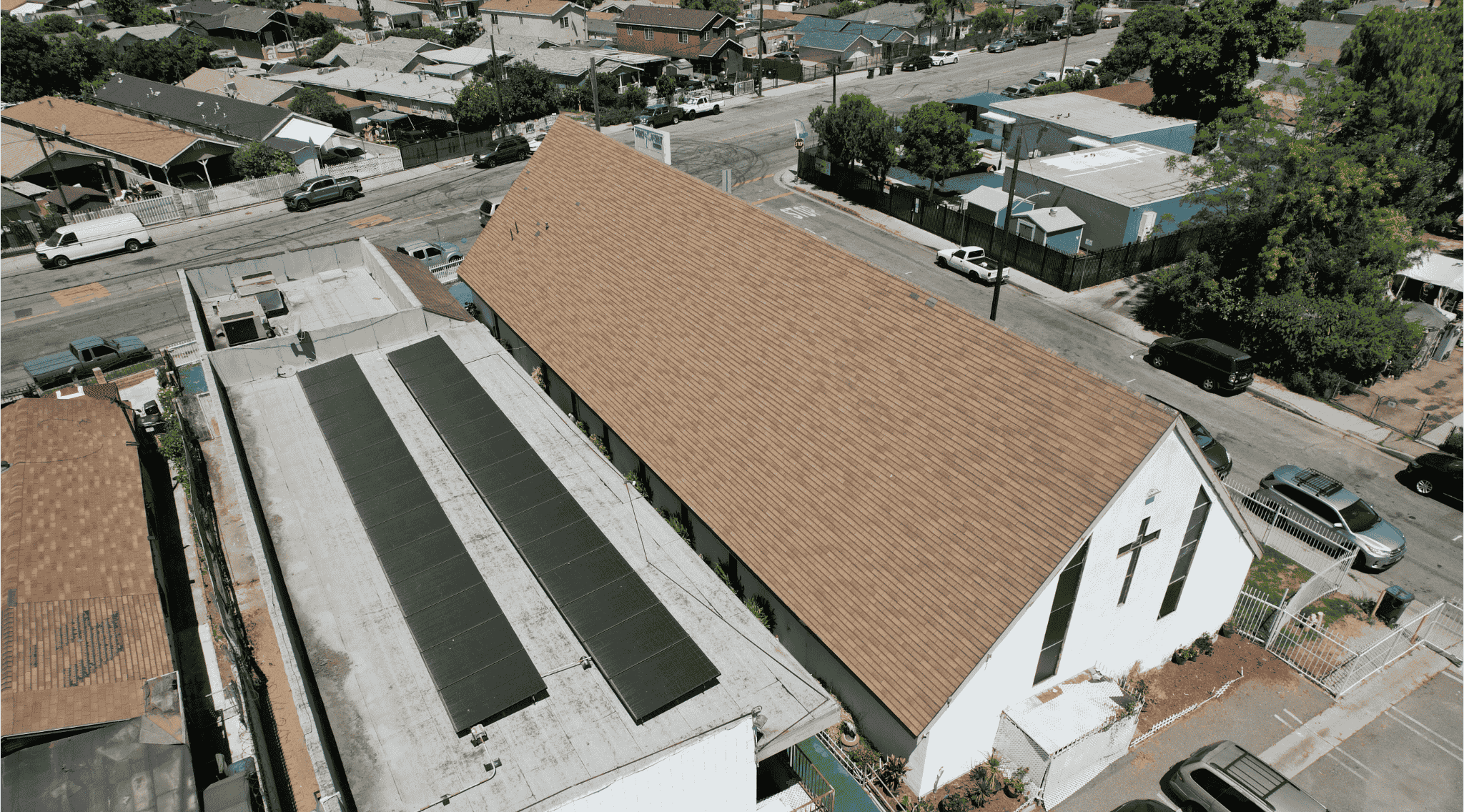
An African American Methodist Episcopal church in a frontline climate community. Solar installation reduced their energy costs by 40%, freed up budget for after-school programs, and made the church a community resilience hub during grid outages.
Pennsylvania Rural Church
A small rural church projected nearly $70,000 in lifetime energy savings from a modest 30kW rooftop array, enough to fund a full-time youth pastor for two years.
See more nonprofit solar stories →
Common mistakes to avoid
Waiting too long
Solar financing programs have annual capacity limits, and the IRA's direct-pay benefit is strongest for projects that start now. Many nonprofits delay 18 months while researching, then discover their preferred program is full for the year.
Not getting multiple proposals
Solar pricing varies 20-30% across installers. Get at least two proposals and compare both the upfront price and the estimated 25-year energy production (where the real savings live).
Underestimating the importance of orientation
A north-facing roof can produce 30-40% less than south-facing, and a heavy-tree shaded site can lose 50%. If your primary roof is shaded, ground-mount systems on a parking canopy or adjacent land may be a better path.
Ignoring the IRA direct-pay opportunity
If you're considering direct ownership, the 30% direct-pay provision is genuinely transformative for project economics. Make sure your CPA understands it.
Treating solar as one-time vs. multi-decade
Solar is a 25-year operational decision, not a one-time project. Plan for inverter replacement around year 12-15 (typically $5,000-15,000) and roof maintenance underneath the panels.
Frequently asked questions
How long does the whole process take?
From application to operational solar, plan on 6-12 months. The financing/eligibility phase takes 1-2 months; installation takes 3-6 months. Larger or more complex projects take longer.
What if my nonprofit has bad credit or no credit history?
Different financing partners have different underwriting. Some (like RE-volv's recoverable grant) underwrite primarily on operating history and building ownership, not credit. Talk to a few partners, your specific situation matters.
What happens when the agreement ends?
Depends on the financing path. PPAs/leases typically offer to extend, sell to you at fair market value, or remove the system. Recoverable grants and direct ownership leave you with the system free and clear.
Can our nonprofit also get state or local incentives?
Often yes. Many states (NJ, MA, CA, CO, etc.) have nonprofit-specific solar incentives that stack on top of the federal direct-pay benefit. Your installer or financing partner should know your state's programs.
Ready to take the next step?
If your nonprofit is mission-aligned with climate action and you'd like a free assessment of whether solar makes sense for your building, start with our 5-minute application →. We'll review your eligibility and arrange a free consultation. No upfront cost. No obligation.
If you're not quite ready and want to keep learning, our newsletter sends monthly updates on nonprofit solar projects, new financing options, and regulatory changes.
Want more solar insights for nonprofits?
Get the latest updates on solar projects, community impact, and how you can help. No spam.